Sunday, October 28, 2012

Welcome to Filadelfia or Meet the Mennonites


Creepy. This word best describes Filadelfia, a small small town in the north of Paraguay, right next to the Bolivian border. I get off the bus and step into a breathtaking heat of 37 degrees (at 9 PM!!) and the first thing I see is two tall blond people with blue eyes walking by. Weird. They speak in German. Unusual. A car stops, two women get off, they speak German. Rare. I walk into the next hotel to make a phone call, all the signs are in Spanish and German. Freaky. The woman at the front desk addresses me in German. I am creeped out. What happened? Where am I? I thought I was in the middle of nowhere in Paraguay and not back home in Germany. As history goes, during the 1920s a big group of Mennonites migrated from Germany to the new world and some of them settled down in the north of Paraguay. So Filadelfia has become a little German oasis in the wasteland of the Chaco region. For anybody else, it might be fascinating or interesting to see how this little town is totally under German command. They only make out about 33% of the population (the rest being indigenous people and Paraguayans) but they control the city. They run the city's “cooperativa”, a self-run civic union which runs like a city hall. People pay taxes, the cooperativa makes sure everything in town runs smoothly. In 2006 Filadelfia officially became a town and a formal process of municipalization was initiated, meaning, it became as bureaucratic as any city. However, the Germans took care of that, too. As soon as they realized that their cooperativa would get competition, they made sure their people ran for city council. So now the German control both, the private business and the city affairs. Creepy. The Mennonites in Filadelfia are of the more liberal kind (not like the Amish – who formed as a splinter group from the Mennonites in the Sates, although most people who are called Amish are actually Mennonites). They have cars and TVs, use cell phones and drink beer. Although, in the only supermarket in town, you cannot buy alcohol. Of course, there is another small (German-run) store where you can get everything from wine to Whiskey if you are willing to pay the high prices. The indigenous population seems to be willing to do it – you can find them in hordes along the main road, drunk and passed out, after 6 PM every day. All of this was explained (and later experienced) to us by our German Mennonite couchsurfing host, Damaris. Damaris, whose age we haven't figured out (bestimates range from 30-50) and who works as a social worker for the city (Quote: “It's important to help the indigenous people, they have a long history of domestic violence, teenage pregnancy and alcohol abuse.” Quote 2: “We don't mingle too much with the indios. You know, it's difficult if you cannot interact on the same intellectual level”).
I was thrilled to be able to talk in German again, find any German product I might have missed in the supermarket and even listen to some people speak Plattdeutsch (a dialect from the north of Germany). Also, listening to a conversation the lady from the tourism office had, organizing a tour for 40 people from A to Z was a skill I certainly did not expect to encounter in Paraguay. However, I also remembered how annoying German schedules can be (if something closes at 11.30 am and you get there at 11.31 you will be thrown out), and how rude (Germans call it direct) my people can be. I was literally barked at, in German, of course, to put my purse in a locker before entering the supermarket. I have to admit though, 2 days in Filadelfia was about as much as I could take: hot + humid + too many Mennonite Germans = CREEPY!  

Ciudad del Este: Welcome to Gotham City


I had been warned. Many times. People get robbed there. Assaulted. Killed. Everybody who had been to Ciudad del Este in Paraguay before seemed to have a different horror story about it. “I didn't think of anything bad walking down the street and this guy came up with his gun and I had to give him my wallet.” “They warned me not to walk down the bridge but I didn't have money to take a cab so I walked anyway. Next thing I knew, three sketchy men walk up, point a gun to my head and ask me for my money. Obviously, I didn't have any, so they robbed my shoes.” So I imagined a Paraguayan Gotham City crossing the border from Foz de Iguazú (a lovely city on the Brazilian side of the Iguazú falls) to Ciudad del Este. The first person I met though was a charming lady at the tourism office (right next to the migration office) who took her time explaining to me all the sights of the city, where to go, where not to, how to get there and how much it would cost. When we were looking for a public phone to call the couchsurfer we were staying with, she just let us use her cell phone. That was our first introduction into Paraguayan hospitality. Friendly, warm, welcoming and always willing to help out a clueless gringo.
From the migration point it's only a short walk into the city center, however, unless you might collect stories like the ones mentioned above, don't walk!! Even if it's just a street, take a cab! There is all sorts of creatures trying to sell you electronics, money or drugs (and I am not sure if they aren't cops in disguise...). But once you manage to get downtown, it's … well, now here it takes a little bit of extra effort trying to describe what the hustling and bustling city center of Ciudad del Este looks like. First off, 90% of the people are Chinese or Korean. Second, they all try to sell you something, or anything really: clothes, purses, watches, cell phones, food – you name it. Ciudad del Este is South America's biggest trading city, since it is tax free, everything here is cheap (and fake or made in China) so it became a huge market for especially Koreans and Chinese. Ciudad del Este is also the only city in South America I have been to so far where people work Monday to Saturdays (and acutally WORK, not just sit at their desks, checking their facebook) – because the Asian bosses make sure nobody is standing still at no time. And then downtown Ciudad del Este is just a giant Chinese market. Stand after stand after stand, everybody trying to get through, shoving and pushing, and – obviously – looking for the best deal. It was a little bit hard for me to actually understand what the vendors were saying to ME. Since I don't look Paraguayan, the next best guess is that I am Brazilian – so most people would say something in Portuguese to me and be completely amazed when I actually answered in Spanish! Ciudad del Este is really some sort of free zone, where nothing seems to be as it is in other Latin American cities. The next “sight” was a bar we went to. I am not even sure how to call it. It was a bar, an ice cream parlor, downstairs was a bowling alley, next to it the cheap disco (free but with no AC – at 40 degrees), upstairs the VIP disco (pricey but with AC!) and filled with 15 year olds (note: the teenage men in Ciudad del Este have adopted a very unique way of walking, I call it the Arnold Schwarzenegger walk – walk as if you're muscle-packed and at least 30 cm taller).
One of the most shocking things to me though was seeing armed men in the streets, and I mean your regular shopper or family men, not just security guards. I have never seen armed men like that before (I have not been to Central America before and I am also not from the US where having a weapon is common) – so I have to admit that sitting at an internet cafe next to a big fat gun made me feel somewhat uneasy...
Ciudad del Este is a fascinating place, very much unlike the rest of Paraguay, but never boring!  

Monday, October 22, 2012

Montevideo: The city that always sleeps

mmmm, mmmeat

Candombé parade


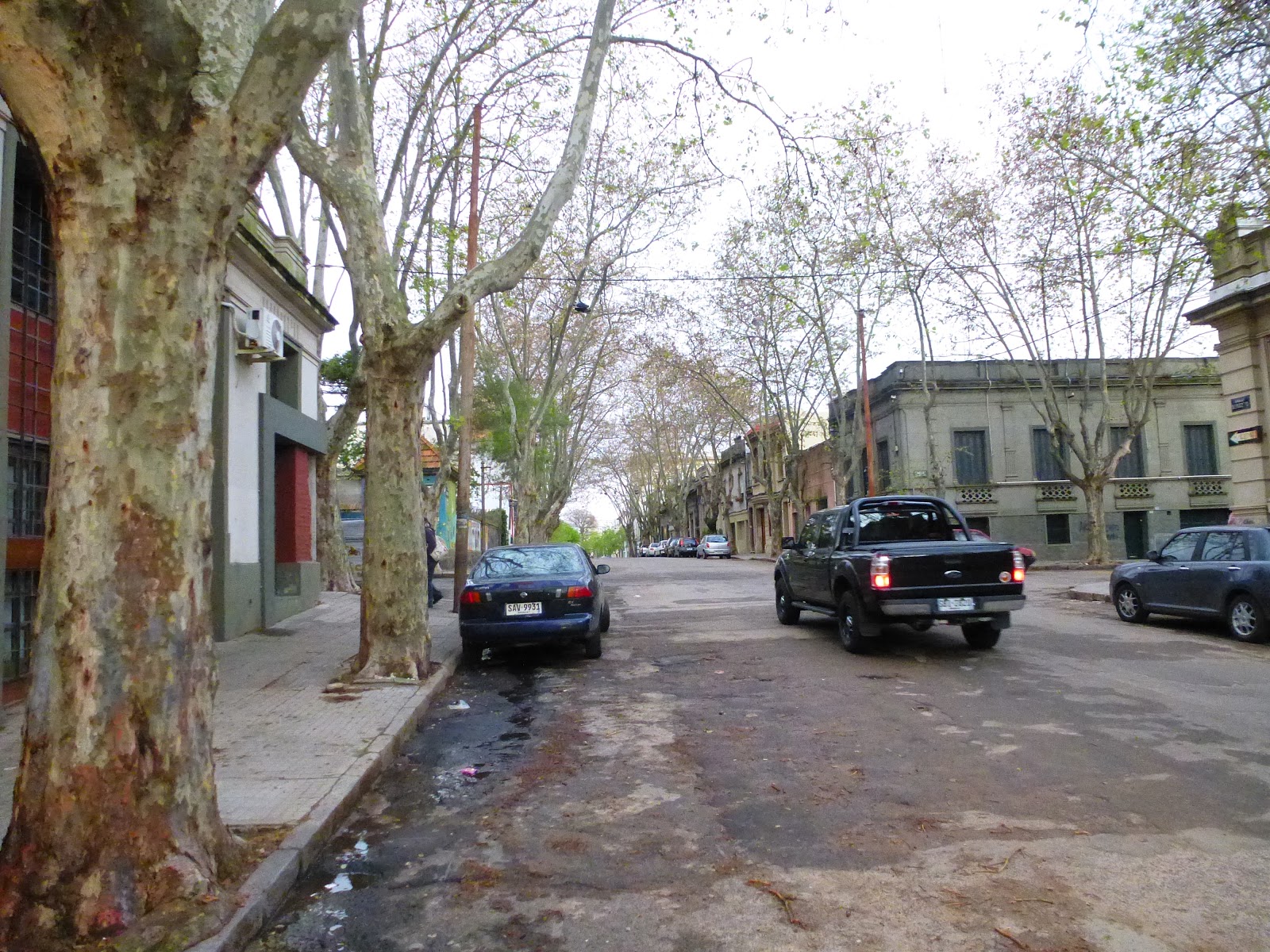
main plaza in Montevideo (where are the people???)

deserted streets

people - anyone?

anyone at all?
finally!

pleeeease!


we found the creatures of Montevideo
Yes, Montevideo  is a beautiful city, but it's a sleeping beauty. Or, at least it was in a temporary coma when we got there. We stayed for 3 days in Uruguay's capital and it seemed like a ghost town. Now, I will admit that it might have had everything to do with a rainy, windy and cold weekend and if we hadn't been touristing, most likely I wouldn't have made it past the coffee machine either. The streets were completely void of people and the ones that ventured out there were very sketchy figures, to say the least! We happened to be there on a weekend of open museums - and fully enjoyed it, since we seemed to be the only 2 people in Montevideo taking advantage of it. So yes, Montevideo has many many interesting museums (carnival museum, a museum of sound, the government building, a museum that show the psychiatric history of the town, old mansions and gentlemen clubs ...) - definitely worth seeing!
Looking for places to eat (proved to be a difficult task on Saturday and Sunday where everything is closed - ??? - ), there is a great variety of food - from pizza to Armenian restaurants. Apparently, there are big Arabic and Armenian communities in Montevideo - so make sure to enjoy their food! Or asados. Or parrillas! Just meat! Uruguayans love meat! They're a cattle country and it shows. My favorite: a take-out BBQ. It's like a restaurant but they have these giant grills where all kinds of meat is roasting (even for me as an almost vegetarian a great sight) and you can pick your piece of meat, steak, your sausage or whatever you like and in about 10 minutes it's ready to go! Love it!
To be fair, on our first night we did get to see a very impressive candombé parade. Montevideo is famous for its candombé tradition (not CANDOMBLE), a tradition that came with its African slaves. Originally, the drumming sounds were made by captive slaves in order to communicate to other slaves what tribe or nation they belonged to. Walking and dancing along to the drumming sounds became something slave owners started competing over: Who had the best musicians and dancers among his slaves. Nowadays, the Uruguayan Candombé is practiced every weekend and especially during carnival season. So far the official definition. If you are in the middle of dancers and drummers, it's a big, loud, chaotic, charming and simply wonderful street party. People on the streets just stop walking and start dancing along with the formal group of dancers and drummers - to an extent that one procession can block traffic for many blocks and for hours! If you ever go to Montevideo, just follow the sound of the drums and you'll find yourself in the middle of a Candombé party!
The most action we got from our stay in Montevideo, however, was a classic fist fight. Outside a bar all of a sudden we see this huge commotion (somebody had said something to somebody else and this somebody else apparently didn't like it) and people forming up into two groups. Next thing you know, they were beating each other up - until some girlfriends stepped in and dragged their boys away from the fight (quote: "What the hell are you doing there fighting?? - Well, he's my friend. - "So what?! You don't even know what they were fighting about. We had an agreement - when we're out together you don't fight any more!" - Yes, honey. I am sorry sweetie. It won't happen again, I promise.). Meanwhile our Uruguayan friends apologized over and over again, insisting that this usually NEVER happens ("Montevideo is such a tranquil city, nobody ever fights here!" - Yes, we had realized!). Well, what can I say, we were the first spectators in line, cheering for the fighters. Finally, some action in Montevideo!